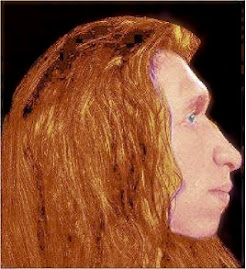
Redheaded Neanderlady

Redheaded Neanderlady
This is a photoshopped version of something I found in National Geographic about the time I started researching

Thursday, July 9, 2009

On "writing forsoothly"

On one of the e-mail forums I visit, there has recently been a discussion about the use of archaic or "period" language in historical novels. I should make it clear, that  what I'm writing is not, strictly speaking, a "historical novel", though it does take place in "historical time". And it's centered around very real events, and has very real people in it.  That said, due to the nature of the documentation of this particular early medieval period, there has been a lot that I've just had to guess at and quite frankly, make up. On the other hand, I'm doing my best, in rewriting the first draft of my first book(it's a romantic science fiktion trilogy), to get the historical events at the very least, in the right order, and have the real people(and their fictional allies and enemies), in the right place at the right time.  Some of the events are a little confusing,and I haven't been able to find or create a straightforward timeline to help me out. 


Be that as it may, I am not writing in what some people call "forsoothly" style.  I don't find it very pleasing; to me, it is just a distraction from the story. By "forsoothly", or "gadzooks" or what I call "fake poetic", I mean a deliberately "archaic" way of writing, using lots of "nay", "aye" "ere", "tis", "twas", unnecessarily convoluted sentence structure, unnecessarily formal usages such as "upon" for "on",and so on. Incidentally, one well-known romance writer has labeled this sort of language "twisy-twasery", which I think describes it perfectly. 


People who write about, say, Elizabethan England might be able to get away with this kind of "twisy-twasery", because that was the way people tended to talk(especially if they had a reasonable education for the day); on the other hand, the writers who have tried this haven't generally been very successful at it. There's just too much of a gap between today's spoken English, and the English of Shakespeare's time. Again, in my opinion, it's best to leave this kind of "twisy-twasery" to Shakespeare,who at least knew what he was doing.


Go a few hundred years ahead to, say, the time ofthe American Revolution. Again, some people have tried to reproduce eighteenth century language for modern readers, and again, most  people have not succeeded very well.  One exception is the book Octavian Nothing, which was deliberately written this way for a purpose.  The author relied heavily on various writings and journals of that time, which are quite abundant.  But this is exceptional , because the rhythms of the speech of that day, no longer really exist in modern spoken or written English.  Sentence structure has become far less convoluted, words that were common 200 years ago have dropped out of the language, people don't wear powdered wigs any more, etcetera.  And we're talking, in both cases, about forms of what is considered "modern" English.  The English language(and other languages as well) have evolved quite rapidly in the last 500-250 years!  We have things like computers, which were unheard of 500-250 years ago, just to give an example. The word "biology" hadn't been "invented" yet(the scientist Lamarck was supposed to have invented it.


So the reader can see why I,for one, don't want to use this "twisy-twasery" in my Great Medieval Science Fiktion Masterpiece With Neandertals.  It doesn't take place 250 or 500 years ago, but nearer 1,000!  And the "English" people spoke then, was convoluted, all right.  It had a grammar and sentence structure more like German(which language has also changed a lot).  No one nowadays would be able to understand it for the most part, so why use "archaism" to suggest it?


I don't know, but some authors do, even when they're writing about a period where the language spoken would have been more or less incomprehensible to a modern speaker of that language.  And some readers seem to like this convention.  I suppose, as one of the participants in the discussion pointed out, it's a matter of taste. Readers who aren't writers might not notice these "conventions" quite so much.  No, they might not notice them at all, especially if the writer is also a good storyteller.  Which is important, and I will get to that shortly.


But writers, once they actually begin to write, start noticing these things.  It's an important part of the process of learning to write.  And it annoys some of them, including me.  From my point of view,if you want to transport people to a different time and place,whether it is 1000, 500, or 250 years(or even back in, say, the 1960's), there are better ways of doing this.  Describe the houses, the clothes people wore, mention the important people and events and how your characters react to them.  You don't have to dwell on this, just sprinkle these tidbits throughout your narrative!  Besides, as an author I quoted pointed out in an earlier post, people speaking to one another in an earlier time, sounded "contemporary" to each other! 


Still, to some readers, who "expect" characters living in historical times to "talk historical", writing in what I kill "modern standard" might be jarring.  To them, I can only say two things:  first, I'm not writing a strictly "historical" novel(it's really a type of science fiktion), and second, because it's something of a "hybrid", I don't exactly see why I should write "twisy-twasery"(I really like that phrase).  Yes, to a reader, this is a matter of taste, I suppose.  For a writer, some stylistic conventions are just too jarring.  This is one of them.

Anne G

Wednesday, July 8, 2009

Why I won't write biographical fiction

For some time now, I've been kritiquing two very different works-in-progress by writers who specialize, or want to specialize, in biographical fiktion.  For reasons that have to do with the nature of the critique group, I can't go into much detail about them.  However, I ken speak in general terms about them.  One of the  biographies is about a person I've heard of, but just barely.  The other is a fictional biography about a person I never heard of, and about whose time period I know almost nothing about.  It so happens that the subject was married to someone I've heard of, but also know almost nothing about this person.  Though the writing in the first book I mentioned is a bit "lumpy" -- that is, there is a lot of work and polishing to do, the author still manages to tell a very interesting story -- so far -- about this particular person's life, or at least that part of the person's life.  The author has, in other words, an instinctive gift for creating sources of conflict,and therefore making an interesting and readable story. 


Which brings me to the second book I'm critiquing  The writing in this particular work-in-progress is much more polished, most of the time.  And the author has a gift for creating very vivid scenes.  However, the overall tone of the book is, well -- episodic.  As a consequence,  it's a much less interesting story, in my opinion.


There's a fair amount of biographical fiction around these days.  Apparently, a fair number of readers like it,and some writers have said they only feel comfortable writing about known characters with lives around which they can build a story(mainly by inventing dialogue and thought processes).  Some biographikal fiktion is actually very good(here, Sharon Kay Penman comes to mind, mainly because she writes about "larger-than-life" people who lived very "dramatic" lives.  It is easy to write interesting biographikal fiktion about such people; you don't have to do much "inventing" because the potential conflicts are already there.


Unfortunately, most people's lives aren't that "dramatic".  This is true even of famous, "larger than life" people.  Besides which, many of these writers tend to choose subjects whose lives are very well known(think Henry VIII, Elizabeth I, Napoleon, Marie Antoinette, etcetera), whose lives have often been written about.  Some skilled writers ken make drama out of the lives of such people, but mostly they don't succeed very well.  And for this reason, though such subjects are potentially interesting, I tend to find most biographical fiktion rather boring, largely because I already know the trajectory of their lives; there's no real drama and/or conflict.  Or if there is, it is presented in a way, that, like the second author I mentioned, is basically "episodic".  Because most people's lives are "episodic".  One thing after another happens in their lives, but the things that happen are not, in themselves, particularly dramatic or interesting. And that is the problem.  Tastes differ, and for a lot of people, if they don't know anything much about Elizabeth I or Napoleon or George Washington, or whoever, then reading an "episodic" fictional account of their life,will be interesting, and perhaps they might even learn enough, to try to discover more on their own.  I used to do this a lot when I was in high school, and I learned a lot about the people and the historical context in which they lived their lives, besides reading some fairly decent authors who wrote about them.


The authors who do biographikal fiktion nowadays are also quite good, and there's nothing wrong with their output.  A lot of people enjoy the works of Elizabeth Chadwick, particularly her biographikal fiktion about William Marshal, who was most definitely a larger-than-life character.  There were some aspects of his life that were quite dramatic, too.  But most of the biographikal fiktion I've read, is written by authors far less skilled than Ms. Chadwick or Sharon Kay Penman(my only problem with Penman, really, is her tendency to write "forsoothly"/in "gadzooks" style/in "fake poetic"; please, pretty please with a cherry on top, the next time you write a book about medieval England, write it in plain,standard modern English!).  And the results of their efforts are -- episodically boring.  I've never finished a book of biographikal fiktion by any of these less talented authors -- and no, I'm not mentioning any names.


Of course, I probably shouldn't complain.  I'm writing a "hybrid" of sciences fiktion and "historical epic", which I kill "romantic science fiction".  But though there are historical characters in it, one of whom is definitely a "main" protagonist, and there are other historical characters throughout, I'm not writing "biographies".  Besides, the majority of characters are strictly fictional, although I've done my best to be as historically accurate as I can.  I think I owe this to the probable "crossover" crowd that might be interested in reading my efforts, assuming I can finish the thing and then get it published.  Besides, tastes differ. Some people really do like biographical fiktion.  But then, some people like "inspirational romances" too;.  You won't catch me writing those, but I would never say "don't read biographikal fiktion" or "don't read inspirational romances".  Some people really like "hard" science fiktion, but I'm not one of them, and furthermore, I don't think I"m technically proficient enough to write "hard" science fiktion.  There are a lot of people who like to read Jane Austen's corpus. I've never been able to get into Jane Austen, but I sure like Dickens.  The point is, there's nothing wrong with differing tastes.  But I don't much care for most biographikal fiktion; I think it's a bit too limiting as a subgenre for most writers to do really well.  But that's me.  And that's why I won't write it.  I don't think I can do it well enough, but then, tastes can change.  And who knows?  I might write biographikal fiktion some day, if I ken find somebody whose life isn't too "episodic", and I have time to do the proper research. . . .

Anne G
"

Thursday, July 2, 2009

The medieval year, one version, or maybe many

The blog Got Medieval -- which often has very interesting tidbits about one medieval subject or another, posted a very interesting blog yesterday.  It's called Welcome to July.  The blog informs us that in July, peasants usually had to bind the ripened grain they grew into sheaves.  In July.  Now I don't doubt that medieval peasants did a lot of "scything and sheaving" in July.  The grain had to be laid out to dry so it could be stacked and then made into sheaves.  Usually, the weather was warm enough and dry enough so that this could be done relatively easily, barring the odd rainy day or so.  If that happened, the grain might rot and people might end up hallucinating all sorts of things, due to ergot poisoning(yes, this happened). The other thing that is important to understand about medieval agricultural economy is that June and July were months of relative "scarcity", though in the earlier medieval period, especially from about 900-1300 AD/CE -- In the so-called "Medieval Warm Period", this wasn't too severe a problem anywhere.  Medieval people had other problems at the time, but I won't go into those at the moment.  IN any case, or at least in some cases, the way the months were named in various places, tended to reflect either the kind of activity that was going on at the time, or the weather and climatic conditions.  In some places, the months were not named January, February, March, etc., but something else.


Here is a list of "modernized" Old English months.  From the descriptions, the reader can see what people in England, at least, did at any given time of the year


January  -- Wolf Month(guess why?)  I've seen paintings of Romanian villages surrounded by wolves in winter,  so it's not just the medieval English that worried about such things

February -- Kale Month  Kale is a very hardy dark green vegetable.  A lot of "foodies" eat kale today, in January and February, when few other green vegetables will grow, even in a relatively "mild" climate like the Pacific Northwest.  It's supposed to be rich in all kinds of things that are "good for you".

March --  Lent Month, and that's where English-speakers get the liturgical season of Lent, since the days are beginning to lengthen.

April  -- Easter Month(and I'll leave to your imagination what liturgical season that has morphed into in the English-speaking world).  There's more to it than that, but again, I won't go into it at this moment.

May  -- Mead Month, probably because flowers really started blooming and bees started producing honey, an important ingredient in the alcoholic drink, mead,which was probably an important source of income for at least some people

June -- Hay Month.  This is when the "scything" or "haying" of grain began, and the weather was probably (mostly) good enough to lay it out for later stacking into sheaves.

July -- Summer Month.  Well, that's pretty obvious.  July is a summer month.  And that's when the "sheaving of grain is in full swing, according to Got Medieval.

August --  "Ern" Month.  I'm not sure what this means, but it was a busy month for medieval peasants, because the grain harvest was probably going on in full swing.

September -- Harvest Month.  Again, this is pretty obvious. This is when agricultural produce was harvested in earnest, and the agricultural season could be assessed as to its relative success.  Other produce was probably also harvested, and preparations made for the coming winter and leaner spring season.  This was also the season of "harvest festivals".  In modern times,it tends to also be the season of things like county and regional fairs.

October  -- Wine Month.  If the modern reader thinks this Old English name for the month is peculiar, think again of the Medieval Warm Period.  In England, wine grapes were grown as far north as the property of Ely Abbey.  Once it cooled off(the Little Ice Age), neither Ely Abbey, nor any other place in England, could grow wine grapes.  Now, I'm told, people are growing wine grapes in parts of England today.  Thank you, global warming(I guess)!

November -- Wind Month.  That's pretty obvious, too.  At least from a "Pacific Northwest" point of view.  It can get pretty blastingly windy in November and December, and we've had some rather awful storms in that month, coming out of the Bering Sea.  Of course blastingly windy winter weather didn't come from the Bering Straits to England, then or now, but  winter winds did, and awful wind and rain storms were noted in certain years, by monastic chroniclers.

December -- Midwinter Month.  Again, pretty obvious.  December is the month winter begins, according to various calendars. Again, interestingly,in modern times,  meteorologists calculate a "meteorological winter" from December 1st. Which makes sense for much of the US, and probably much of Europe, as well.  Although I did read, some years back, in a book called -- get this -- Weather for Dummies -- that the Pacific Northwest has neither winter,nor summer, according to meteorological calculations.  There's no "winter", in most of Texas, either.  But summer starts on or about April 15.  I know this is true, because I lived it.   That, at least, was one problem people in medieval England didn't have to cope with!

Anne G

Friday, June 26, 2009

Some ways you might not have thought of, to tap into your creativity

A couple of months or so ago, I discovered a book called Tarot for Writers.  This is a neat little book, and for those rationalists among us, it is not "about" divination, unless you think tapping into the creativity everyone has within, a kind of divination.  Be that as it may, although I haven't used it as much as I might -- how to squeeze the time in, to do this, in one's ordinary, non-writing life, is always a problem -- I've already found it useful in developing or bringing out things about my characters that I wasn't consciously aware of. 


So I recommended the book to several fellow struggling writers.  I don't know if most of them used it, but Nan Hawthorne noted that Yours Truly mentioned this to her in her latest blog(those interested will have to scroll down to see Yours Truly being noted).  She also noted that there is a Tarot for Writers website, which even offers readings that help the writer develop their plotlines.  I also noticed you can get a reading for your characters.  In my case, that would be kind of difficult.  Since I'm writing about people who were born (a) on another planet in a nearby solar system during the Earthly medieval period and (b) I'm writing about people who were born during a time in Europe when records of births and deaths were spotty and approximate at best, this probably won't work very well.  One of the places a (fictional) character came from actually exists, but not in the place I put it in(some historical purists might not like this, but I had a reason for doing what I did; the other place I might have used, was the place of origin of a fairly well-known family).  In another case, I'm not exactly sure where the character in question was born.  Be that as it may, this might be a tool for some writers.  All I'm saying here is, if you're a writer or other creative person, Tarot for Writers might be a useful tool.


In any case, just to give you an idea of how I've been creatively using Tarot for Writers.  I will use my lead female character, Illg, as an example.  Almost immediately, after doing a little reading in the book, I was able to assign the High Priestess card to her.  Although she is only fifteen in "our" years when her story starts, she  has what can only be described as "secret knowledge", some of which she only partially knows.  First, she is Dauarga(which the Neandertals who come from this nearby planet call themselves),and nobody on Earth has any idea  -- at least nobody in medieval England does(or anywhere else on Earth, for that matter).  Second, she has some rather unusual abilities, which drive part of the action in the story,and also give the "modern" humans around her some vague idea that there is "something" about her.  And she has to learn how to explain these unusual abilities to people, without getting her into trouble. It is a gradual process; some listeners -- including the lead male character, Hardwin(and no, I haven't quite figured everything out about him yet, so he doesn't quite have a card assigned) -- are willing to hear, and others completely misinterpret or misunderstand.  This is very much in line, in some ways, with the usual interpretations of the High Priestess, who is a symbol of mystery and intuition.  Though young and vital in many ways, because of her origins, there is "mystery" about Illg.  She also has knowledges about things that modern humans in modern times take for granted(she knows what DNA is, but she doesn't call it that, for example). People sense this and that also makes her somewhat "magical" and "mysterious" in certain ways.


I could say I "knew" this about Illg before I started; in a way, she is my best-developed character. I could also say there are "journey" aspects to her story, represented by the very first card in the Tarot deck, The Fool.  But all of the main characters "journey"; while this is not the kind of "literary" fiction that emphasizes "character change" all the major characters have moments of self-discovery, and this is part of what the Tarot is about. 


This method of "getting to know your characters" may not be for every creative person or every writer, but it has helped me, and there will be other characters, and other times, when the use of this book may be beneficial.

Anne G

Neandertals dried mammoth meat and made snug clothes(duh!)

Alas, this particular news got *buried" by another piece of news about the "earliest" flute(where a "Venus" of similar age was found).  This was so exciting, because it is apparently "proof" of how sophisticated "modern" humans are supposed to have been.  I'm sure this was an interesting discovery, all right. And it's good that people are discussing it on various venues.  But. However.  This story suggests something at once exciting and depressing.  Exciting, because if it bears out, it shows that (a) Neandertals could plan for long trips, (b) they knew how to smoke and dry food for preservation and (c) they could make perfectly good, warm, snug clothing -- necessary in the sort of climate they lived in.  They have been denied all of these capacities by various workers, who don't want to acknowledge that, however related they might have been to "us", Neandertals had brains.  And they used them.


Here is the picture that accompanies the articlemammoth-540x380_hmedium

It's not entirely accurate, but it shows the possible clothing Neandertals could have worn, perhaps even while hunting mammoths!

Anne G

Thursday, June 18, 2009

More "accuracy" debates

Over the past few days, more debates on the "accuracy" problem have come up on various venues that deal with certain kinds of fiction, mainly historical fiction. One aspect of this debate has been blogged on here and has inspired a number of comments, including one from Yours Truly.  Another, on Susan Higginbotham's blog, deals with word usage in historical novels.  There seems to be a rather sharp division of opinion about how much "accuracy" should be in novels with a historical theme.  On the one hand, the husband of one of the bloggers, takes the position that "it's a novel", and therefore, the "accuracy" issue isn't as important to him as "a good story".  On the other end, there are extremists who insist that the writer must get every detail "absolutely right. I'm somewhere in the middle, I guess.  For me, "story comes first", especially in situations where, as in the time period I'm writing about, there is little information on some of the historical characters that appear in my Great Medieval Science Fiction Masterpiece, and in some cases,no one really knows what happened to them.  On the other hand, I try to be as accurate about what is known about them as I can, getting them in the right places at the right times, as far as is known.  And especially since I am not, and probably never will be, writing biographical fiction, I do feel I can "invent" certain things, either when little is known about a real person, or when I have my fictional characters react to a real situation.  Since some of them have "crash landed" but are on a mission from a nearby planet in the galaxy(and they look an act perfectly human, though they aren't exactly "modern" humans), they can and do have attitudes that are not of that time and place, though they try to adjust their actions to the realities of that time and place.  What I don't do, insofar as I can avoid it, is have the people who were born and raised in that era, act like "modern" people of the 21st century.  Their motivations and thoughts are quite different, in some ways, from ours.  This, I think, is a reasonable approach to historical fiction(or, in my case, a "hybrid" that hopefully will appeal to those who like science fiction and those who like historical fiction as well).  I don't think it's a reasonable approach to insist on "absolute accuracy" in situations where many of the characters, particularly the main ones, are inventions.  It's also one of the reasons why I'm not writing biographical fiction; I've seen the efforts of some writers who are trying to write this kind of fiction, and the results are, well,episodic. But again, for me, "story comes first".  But also, this is not an excuse for a writer not to do his or her research -- and BTW, this applies not just to historical fiction, but all fiction that has a "background" or "theme" of some kind.


Let me give an example of what I mean here.  I'm currently reading the mystery novelist Nevada Barr's Winter Study.  It takes place on Isle Royale National Park in winter, naturally.  Ms. Barr makes the conditions under which this ongoing study takes place abundantly clear.  The team studies the conditions under which the famous wolves that live in that park, and their prey, the abundant moose,exist in winter.  No visitors are allowed in the park after October(it's frightfully cold there in the wintertime (but wolves and moose have fur coats, at least).  It's just the researchers, the wolves, the moose, and whatever other critters live there in the wintertime.  She also mentions that this study has been going on for 50 years, and lots of people follow the ups and downs of the wolf and moose population.  She also mentions the canid specialist Rolf Peterson, and the "granddaddy" of this ongoing study, David Mech.  These are all real people, the study is real -- they even have a website(try Googling for Isle Royale National Park some time, and  you will probably come across it.  And Rolf Peterson wrote an Introduction to the book, which I will be reviewing when I finish reading it. 


Ms. Barr has quite clearly "done her homework", and it shows.  She also knows a good deal about how the National Park System works, and what she knows, figures into her mysteries, which make them very, very interesting, especially for me, because as I've mentioned elsewhere, I'm "into" wolves, and, by extension, "natural history" and environmental studies.  Though her situations are fictional, the background is quite real, and fairly easily verified. 


The same is true when writing historical fiction(or,for that matter, science fiction based on speculations derived from the study of molecular genetics, as the sci-fi writer Greg Bear has done).  It is imperative to get the basics right; if you don't, somebody  will notice, and complain!  Writers who don't get the basics right, often end up with glaring anachronisms or mistakes; I once read a very shoddily-researched romance(among other things, the names were all wrong for the period) that put a real historical person in the wrong part of England!  Ugh.  But that kind of egregious error is probably partly what prompted me to start writing this Great Medieval Science Fiction Masterpiece in the first place(plus making Neandertals respectable). 


On the other hand, some people can and do go way off the deep end, in the other direction.  I think I've mentioned elsewhere, that Sharon Kay Penman, good writer that she is, has a tendency to "write forsoothly", which often makes me grind my teeth, because,at least for me, "forsoothly" language is just too distracting. Which brings me to the subject of Susan Higginbotham's blog -- language use.  She, herself, prefers modern language, because she notes, quite correctly in my opinion, that use of some words and phrases commonly used in the time she's writing about, would be quite confusing to a modern reader.  One example she gives, is a historical character referring to his "mother-in-law".  "Mother-in-law" is clear enough to a modern reader; the trouble is, this term was used for stepmothers(and presumably stepfathers) in the 15th century.   So she has this historical character refer to his "stepmother" rather than his "mother-in-law".  She also mentions that she feels silly using words like "certes", which is something Ms. Penman does all the time.  In this case, it would make absolutely no difference for Ms. Penman to have her characters(even if they're talking in Old French or Middle English, to just say "certainly", or "for certain", as the situation demands.  There are plenty of other ways to suggest the time period(e.g. referring to certain kinds of armor as "hauberks"), or describing something about the living conditions.  She actually does a lot of this, and quite well, and I think that's enough.  But she, along with some other writers of historical fiction, tends to be what Nan Hawthorne refers to as an "accuracy nerd", and to me, at least, this is silly.


For me, the bottom line is:  strive for overall accuracy in at least the basics(timeline, organization of national parks, molecular genetic studies, etc), and, if you're writing historical fiction, be sure your characters are in the right place at the right time, and are in the proper relationship to one another(yes, I've seen a lot of egregious mistakes here, too).  Get the details right as best you can, and do your research! Beyond that, again, at least for me, "story comes first"; write the best way you know how. Don't strive for a "style" , but write clearly and interestingly.  If you can do this, there is no guarantee that you'll get published, but at least you have the satisfaction of knowing that you gave the best shot to your effort.

Anne G

Monday, June 15, 2009

Flash! Neandertals in the news!

The North Sea has yielded up some Neandersecrets, thanks to some intrepid Dutch scientists. There is an article here,  and here's a picture of what they found, which, though not much, should give us all an idea.

northseaneander


Of course, there seem to have been other finds in the area, though no fossils until now.  But there is evidence that Neandertals existed in what is now the UK, some 60,000 years ago; some fairly typical "Neandertools"  were found near the remains of some hapless woolly mammoth, in Norfolk, a few years back. And there wasn't any North Sea between Britain and the Netherlands 60,000 years ago, either.  They could just follow the reindeer/caribou, or the woolly mammoths, or whatever they were inclined to eat at the time. . . .

Which is all very nice for my heroine Illg, who, with her companions, recognizes places where her "Ancestors" have been.

Anne G